Giới thiệu
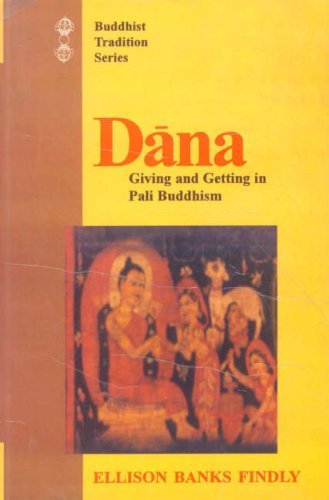
The uploaded document is a book review of Ellison Banks Findly’s Dāna — Giving and Getting in Pāli Buddhism. The review presents the book as a research monograph published under the Buddhist Tradition Series, Volume 52. It emphasizes that dāna is one of the most basic virtues in Buddhism and a first step on the Buddhist path. The reviewer notes that the Buddha often began his teaching to non-renunciants with dāna-kathā, discourse on giving, because attachment is a major obstacle to spiritual development.
The book contains a Preface, an Introduction, and nine main chapters. In the Preface, Findly highlights the role of dāna as a bridge between two communities: the renunciants, or Saṅgha, and the lay followers, or donors. The Introduction further develops this point by describing the interdependence between the Saṅgha and lay society. Laypeople provide the four requisites—food, clothing, shelter, and medicine—while the Saṅgha offers spiritual instruction, especially through dhammadāna, the gift of Dhamma. The Introduction also discusses the reciprocal ethics of the Sigālovāda Sutta of the Dīgha Nikāya and treats three important relational contexts: the child and the family, the renunciant and the Saṅgha, and the donor and the Saṅgha.
Chapter One: Buddhist Donation: A Religious Response to a Changing World places Buddhist giving within the social, political, and economic transformations of sixth-century BCE India. It discusses the emergence of village and town culture in central India, the rise of Buddhist renunciants, and the benefits of the reclusive life. Findly also traces the background of dāna to the Ṛgvedic period, where giving was associated with gifts to priests for ritual services intended to secure blessings such as long life, victory, prosperity, and sons.
Chapter Two: Redefining Relationships: The New Donor examines the relationship between Buddhist renunciants and the gahapati, or householder. The chapter shows that the gahapati was no longer merely the Vedic keeper of household stores, but had become a socially and economically significant figure in the Buddhist context. It also discusses the gahapati as Buddhist layperson, the hindrances of household life, and women as independent donors.
Chapter Three: Resources to Requisites: Gifts to the Gone Forth studies gifts offered to members of the Buddhist order. The chapter moves from Vedic ideas of gifts and ritual patronage to the Buddhist system of the four requisites. It treats robes, alms food, shelter, and medicine in detail, drawing especially on Vinaya materials. Topics include the three ochre robes, the number, material, color, acquisition, and care of robes; the first meal offered to the Buddha by Tapussa and Bhallika; the use of the alms bowl; alms-round practice; acceptable food; proper eating; and rules concerning shelter and medicine.
Chapter Four: Giving Gifts provides a broad examination of dāna in Buddhist ethics. The reviewer notes that dāna is treated as the first principle of Buddhist ethical training for laypeople because it helps reduce greed and prepares one for the path. The chapter discusses dāna in early Buddhist ethics, dāna teachings in Pāli texts, the relationship between money and renunciants, lay wealth, acquiring wealth, using wealth, the confident giver, sappurisa, and saddhā.
Chapter Five: Receiving Gifts focuses on the worthiness of the recipient. Findly discusses concepts such as dānapati, dakkhiṇeyya, and puññakkhetta, and presents a hierarchy of worthy recipients based on the Dakkhiṇāvibhaṅga Sutta of the Majjhima Nikāya. The chapter also examines the idea of the good field of merit, the worthiness of nuns as recipients, the role of food in the field of merit, hungry ghosts, womb-being, feeding renunciants, poverty, and dāna. It also touches on the early Buddhist concept of gandhabba in relation to conception and rebirth.
Chapter Six: Making, Using and Transferring Merit analyzes the central role of puñña, or merit. The reviewer notes that merit is compared to a form of non-material saving or exchange, especially in relation to the Nidhikaṇḍa Sutta of the Khuddakapāṭha. The chapter discusses karma in early Buddhism, including kusala, akusala, and avyākata; merit-making in the context of dāna; the use of merit; the relationship between merit-making and emancipation; and the transfer of merit. Findly argues that merit transfer should not simply be dismissed as a late addition, since Pāli canonical evidence indicates its antiquity.
Chapter Seven studies the relationship between renunciants and property. It discusses the issue of ownership in the Saṅgha and argues that early monastic property, such as monasteries and lands, was dedicated to the whole Saṅgha rather than owned individually or collectively in a modern sense. The chapter also examines how later Buddhist history saw changes toward monastic and land ownership. Vinaya rules concerning property and the four requisites form an important basis for this chapter.
Chapter Eight: Monastic Strategies for Encouraging Dāna: Curbing Misbehavior and Generating Goodwill examines how the Saṅgha was expected to behave in ways that sustained lay confidence. The reviewer notes that the word “strategies” may be strong, because the Saṅgha’s conduct is better understood as normative and institutional behavior shaped by Vinaya. The chapter discusses curbing misbehavior, householders’ complaints, the nature of monastic misconduct, and the importance of monastic conduct in generating faith among non-believers and strengthening the faith of believers.
Chapter Nine: The Renunciant as Facilitator: The Case of Ānanda focuses on Ānanda’s mediating role between householders and renunciants. Findly presents Ānanda as a key facilitator of dāna because of his close relationship with the Buddha, his knowledge of the Dhamma, his popularity, and his social accessibility. The chapter discusses Ānanda as the Buddha’s attendant, his service to both the Buddha and laypeople, his relationship with Buddhist women, his role in the establishment of the Bhikkhunī Order, his visits to nuns, and his function as a mediator between donors and the Saṅgha.
Overall, the reviewed work is presented as a strong contribution to the study of Buddhist giving. Its major value lies in its close engagement with Pāli canonical materials, Vinaya sources, Sanskrit materials, footnotes, bibliography, and index. The reviewer concludes that the book is an important addition to Buddhist Studies, especially for understanding dāna as a practice that sustains both Buddhist ethical life and the institutional relationship between lay society and the Saṅgha.